Skip to content

// Leap Today withDataObserve

The next era of AI.Intelligence you own.

  • Develop models & agents

    // Training

    Build agents that get better at your work.

    Train language models and agents on your own work. Fine-tuning, reinforcement learning and inference run in one system, on DataObserve Cloud or your GPU cluster.

    • Supervised fine-tuningTeach your domain using your data, examples, and expert demonstrations.
    • Reinforcement learningTrain agents to reason, use tools, and complete multi-step tasks with your own environments and rewards.
  • Run your applications

    // Production inference

    Put the intelligence you build to use.

    Turn a trained checkpoint into a model deployment. Bring your own model’s capabilities into customer-facing products, internal tools, and agents.

    • From checkpoint to deploymentSave inference weights and publish them under a model name your applications can use.
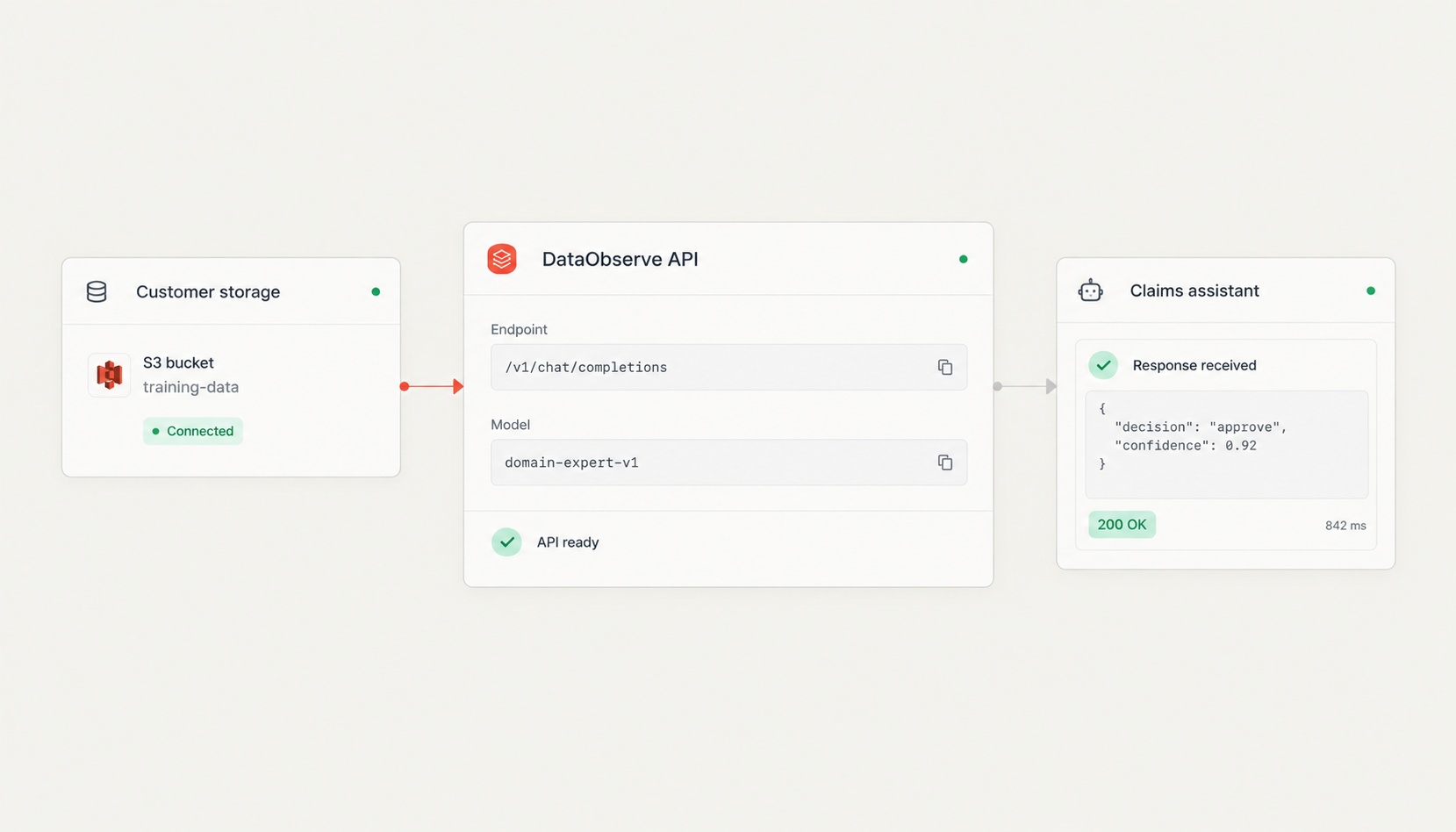
    • Connect through a familiar APIStream responses through Dataobserve’s Python client or an OpenAI-compatible endpoint.

// Control the learning

From experimentto deployment

Your models are a strategic asset. You pick where they run, and the data, weights and compute stay yours.

Open model → your training run

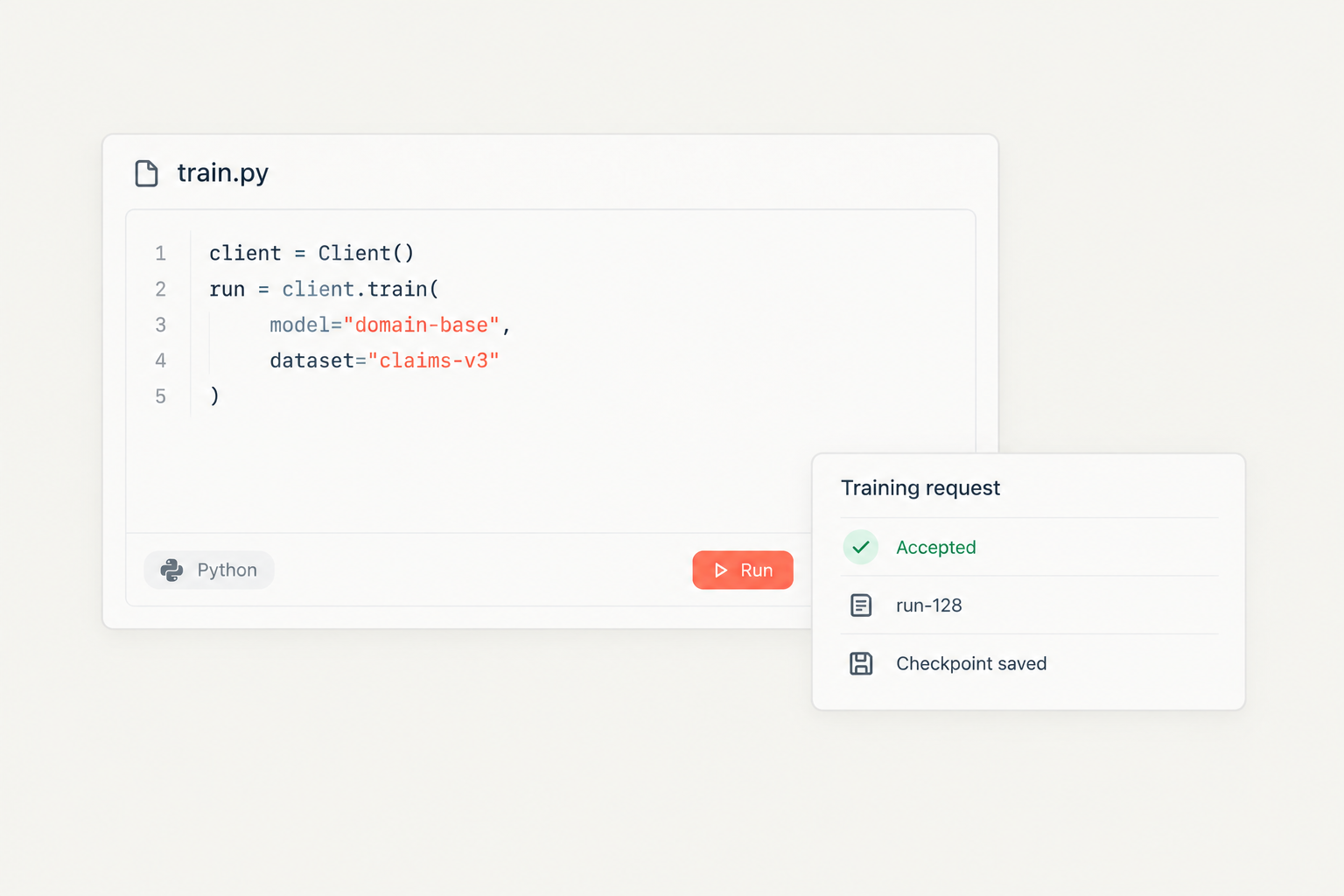
Distributed training from Python

Choose an open model, configure its adapters, and start learning from your data. Dataobserve handles the compute behind each training step.

See your labin action

See what’s happening across your cluster without losing sight of the experiment. The Console brings your team’s training runs, checkpoints, and deployments into one place.

Training Console

// Tuned and tested

Every model tunedand tested

    • Model engineering

      Every model tuned and tested

      We tune each supported open-weight model for training and inference and handle the GPU topology ourselves. Each one is also tested for correctness before you get it. That matters when you compare two models. If the results differ, it's because the models differ.

      • Custom training and inference engines
      • Topology-aware tuning
      • Per-model correctness tests
    • RL reliability

      RL that holds up at scale

      Long reinforcement learning runs fail quietly. A small mismatch between the numbers the trainer expects and the ones inference produced won't crash anything. It just bends the learning, and you find out two days and a few thousand dollars later. We test for that mismatch, check for numerical instability, and stress-test the API under load. Your researchers get to work on agents and new algorithms.

      • KL mismatch checks
      • Numerical validation
      • Load testing

    // Distributed inference

    State-of-the-art inference on any accelerator

    A Kubernetes-native stack that runs vLLM, SGLang and other engines across your cluster, turning single-node engines into production-grade serving.

    • // Router

      LLM-aware load balancing.Every request is queued, scored and sent to the model server best placed to answer it, without a custom proxy.

      • Endpoint pickerScores pods on live metrics, KV-cache affinity and your policies
      • Flow controlMulti-priority queues, fair sharing and overload protection
      • Latency predictorPredicts time to first token and per token to meet SLOs
      • Gateway API
      • Filter · Score · Pick
      • Admission control
    • // Model servers

      The engine that fits the job.Accelerator-native engines load the weights and run the forward passes, with dynamic LoRA serving.

      • vLLMPagedAttention, tiered offloading and RDMA KV transfer
      • SGLangRadixAttention and hierarchical caching
      • TensorRT-LLMIn-flight batching and specialised kernels
      • Dynamic LoRA
      • Standard metrics
      • OpenAI-compatible
    • // Disaggregation

      Prefill and decode, each on the right hardware.Split compute-bound prefill from memory-bound decode, and scale mixture-of-experts models across nodes.

      • Prefill/decode splitSpecialised workers with fast RDMA KV transfer between them
      • Wide expert parallelismData-parallel attention and expert-parallel layers for MoE
      • Rank-aware routingRequests land on the ranks that hold their experts
      • RDMA
      • MoE
      • Multi-node
    • // KV cache

      Compute a prefix once, reuse it everywhere.Track cache state on every server, route to the warmest cache and extend capacity into CPU and SSD.

      • Prefix-aware routingHeuristic and precise routing for higher cache hit rates
      • Tiered offloadingCPU and SSD tiers extend effective cache capacity
      • Peer-to-peer sharingFetch cached blocks from a peer instead of recomputing
      • KV indexing
      • Offloading
      • P2P
    • // Autoscaling

      Scale on latency headroom, not CPU.SLO-aware autoscaling driven by router metrics, with multi-node pod groups that start and restart together.

      • Queue-driven scalingQueue depth, saturation and token backlog drive replicas
      • SLO-aware controlClosed-loop scaling on latency headroom against targets
      • Multi-node groupsLeader-worker sets with gang scheduling and versioned slices
      • KEDA
      • LeaderWorkerSet
      • SLOs
    • // Batch & async

      Fill idle capacity with offline work.Run batch jobs through an OpenAI-compatible Batch API, and dispatch queued requests within flow control.

      • Batch gatewaySubmit, track and manage batch jobs and files
      • Async processorPulls from Redis or Pub/Sub and meters dispatch
      • Fair to live trafficBatch work yields to interactive requests
      • /v1/batches
      • Message queues
      • Flow control

    // Well-lit paths

    Tested recipes forproduction inference.

    End-to-end, tested deployment guides for common production patterns, adaptable across models, hardware and workloads.

    • Foundation

      Optimised baseline

      A tuned starting deployment for any model and accelerator.

    • Foundation

      Predicted-latency routing

      Send each request where it will meet its latency target.

    • Foundation

      Precise prefix-cache routing

      Route on exact cache state for the highest hit rates.

    • Foundation

      Tiered prefix cache

      Extend cache capacity into CPU and SSD.

    • Foundation

      Prefill/decode disaggregation

      Separate workers for each phase, joined by RDMA.

    • Foundation

      Wide expert parallelism

      Serve large mixture-of-experts models across nodes.

    • Foundation

      Multimodal and omni models

      Serve image, audio and omni models on the same stack.

    • Foundation

      Stateful Responses API

      Serve the stateful OpenAI Responses API for agents.

    • Operations

      Flow control and fairness

      Multi-tenant quality of service under load.

    • Operations

      Workload autoscaling

      Scale the inference pool on SLO headroom.

    • Operations

      Multi-model routing

      Many models behind one endpoint, routed by name.

    • Operations

      Rollouts and fast actuation

      Zero-downtime upgrades and quick model swaps.

    // Any accelerator

    Deploy once,scale on any hardware.

    The same serving patterns run across GPUs, TPUs, XPUs, NPUs and CPUs, so you can move workloads without re-architecting.

    • GPUNVIDIADefault
    • GPUAMD ROCmSupported
    • TPUGoogle TPU v6e, v7On GKE
    • XPUIntel Data Center GPUWith DRA
    • NPURebellionsSupported
    • GPUIluvatar BI-V150Supported
    • GPUMetaX, Biren, Moore ThreadsCommunity
    • CPUIntel Xeon, AMD EPYCNo GPU needed

    // The platform

    Everything a model lab needs.One console.

    Training, inference, datasets and evaluations share one API, so a checkpoint never has to leave the system that made it.

    • Training

      SFT and RL from Python.

    • Inference

      Serve checkpoints behind one API.

    • Datasets

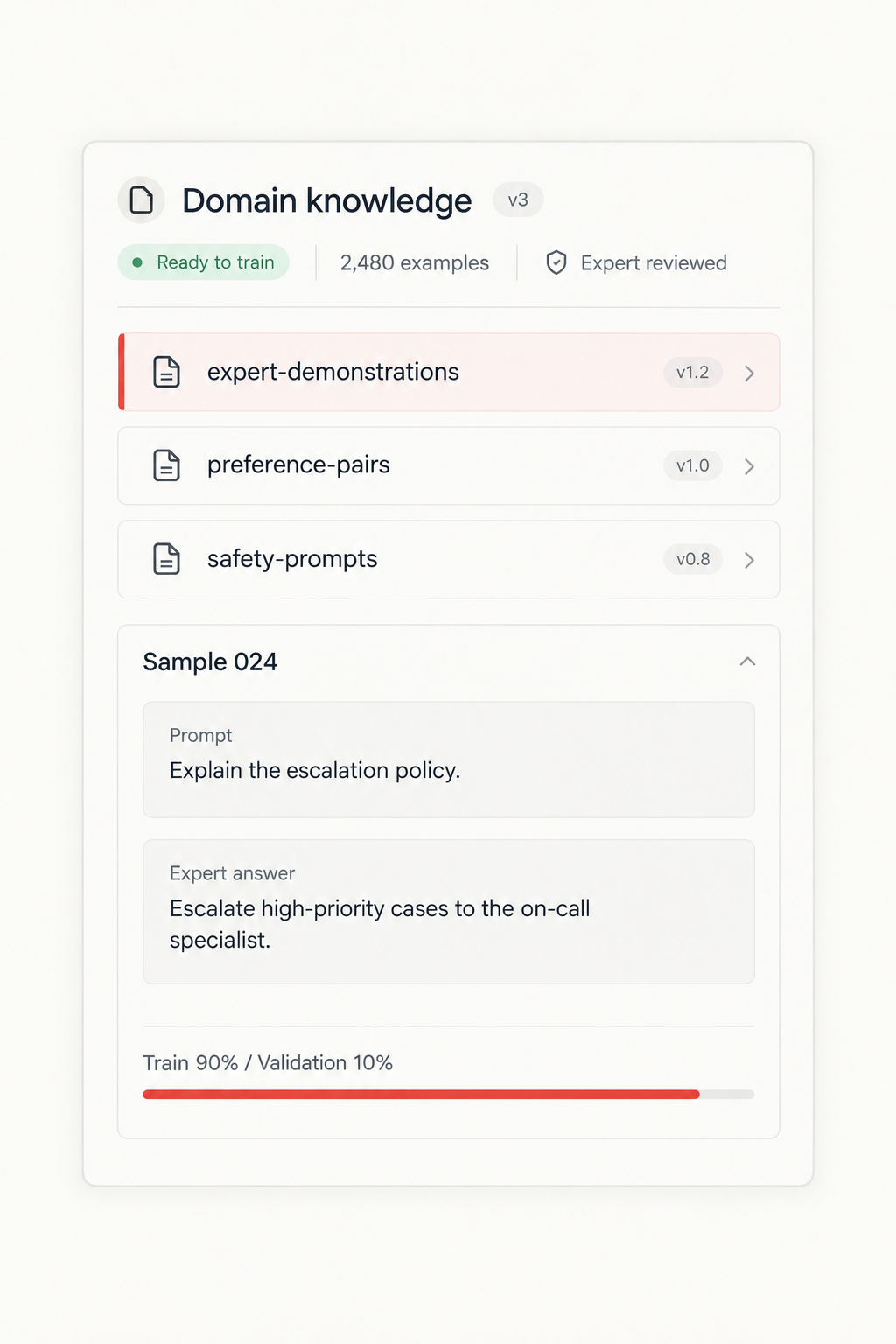
      Expert-written, versioned, ready to train.

    • Evaluations

      Graded sets and red-team suites.

    • Console

      Every run, checkpoint and deployment.

    • Integrations

      SDK, API and your own storage.

    // Security + integrations

    Connect your data with confidence.Built for ML engineers.

    • Integrate with your stack

      Call your model through Dataobserve’s Python client or an OpenAI-compatible endpoint. Bring data from your own storage.

    • Built with security in mind

      Discuss security and sensitive-data requirements for your deployment.

    • Developer-friendly API + SDK

      Train, sample, save and deploy from a few lines of Python. Documented, versioned, scriptable.

    • Built for scale

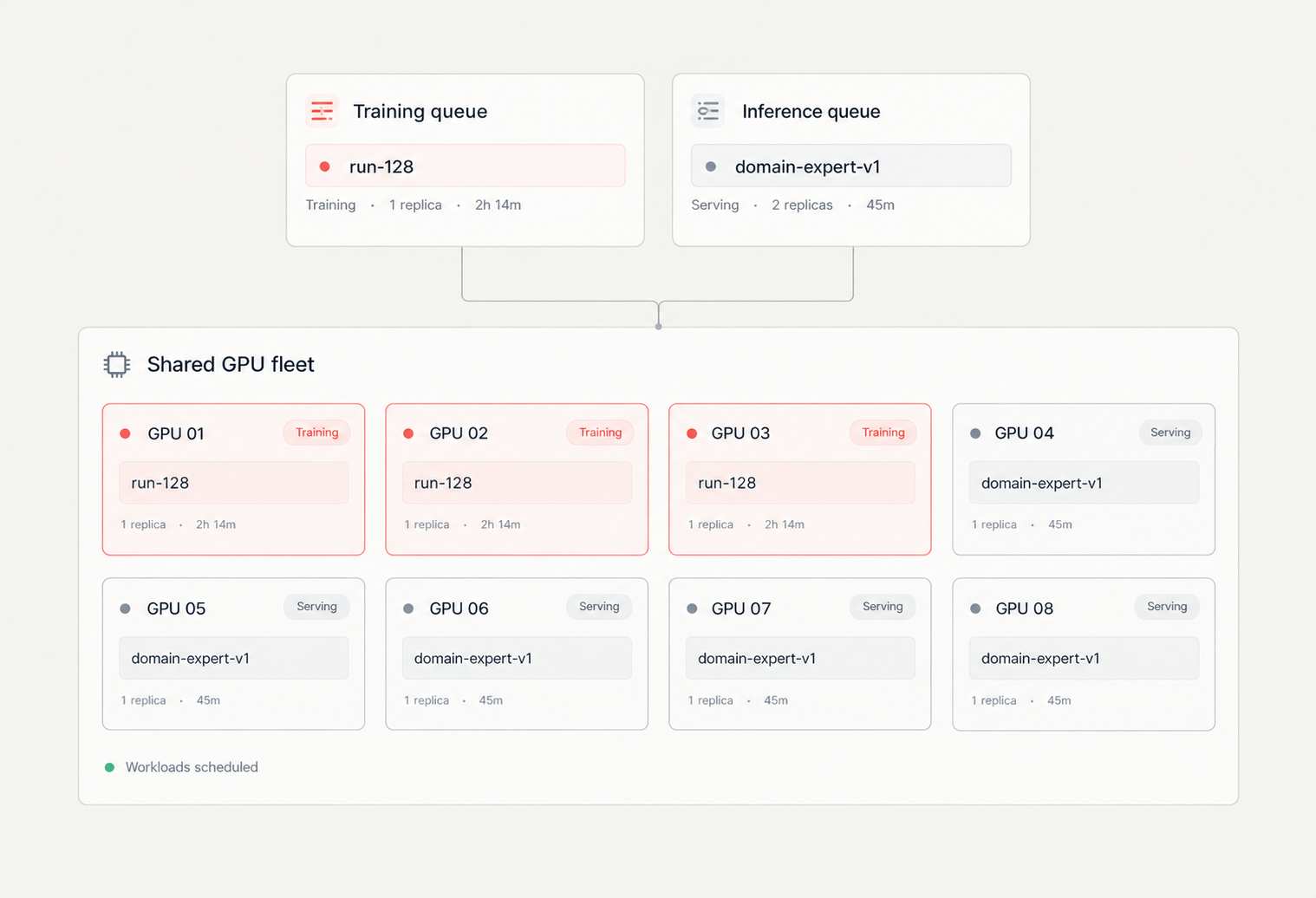
      One shared GPU fleet for training and inference, or the same product on your own cluster.

    // Ready for day 2

    Inference you can operate, not just launch

    • Multi-tenant quality of service

      Priorities and fair sharing keep every team inside its SLO.

    • Zero-downtime upgrades

      Roll models and engines without dropping a request.

    • Agent-aware serving

      Stateful, multi-turn traffic routed to the cache that already holds it.

    • A stable API

      OpenAI-compatible endpoints and Kubernetes resources that won't shift under you.

    • Open source underneath

      Built on open, Kubernetes-native components and standard Gateway APIs.

    // Data + AI Excellence

    Train and Deploy Industry‑Leading Generative and Traditional AI.

    Every model below is open-weight, optimized for training and inference, and tested for correctness. Tags show parameter count; MoE models list total and active parameters. For on-prem model and hardware requirements

    // Generative AI

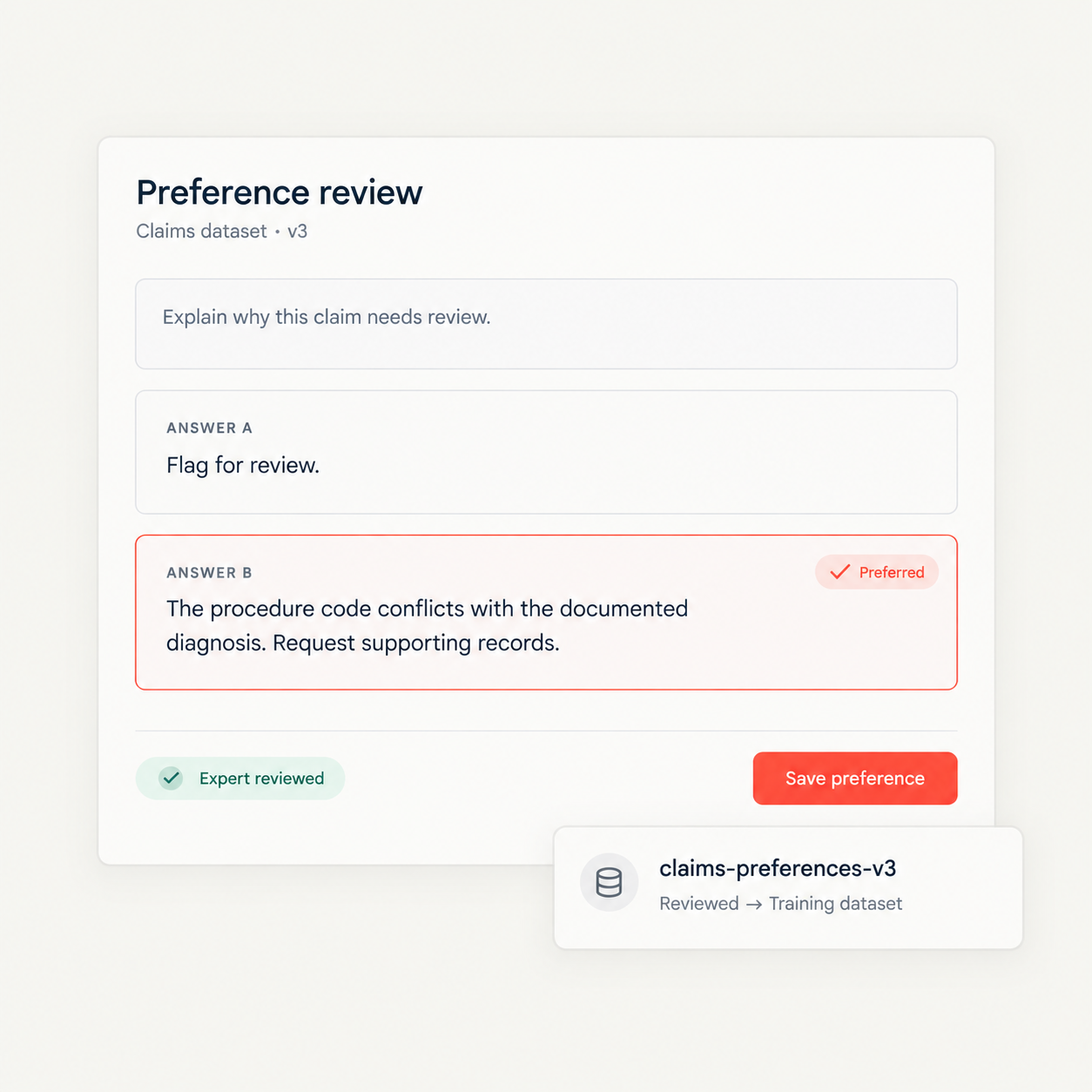
    Fine-tuning data written by the people who do the work.Supervised examples, preference pairs and red-team prompts from domain experts, sent straight into your DataObserve training run.

    • Chain-of-thought + in-context learningReasoning written out step by step, for models that get the answer right and the reasoning wrong.
    • Data augmentationExpert-reviewed perturbations, for accuracy that drops when inputs change shape.
    • DialogTurn-by-turn conversations, for assistants that lose the thread after turn three.
    • Full lengthLong-form writing, summaries and reviews that have to pass a subject expert.
    • Supervised fine-tuning
    • RLHF + DPO
    • Safety, evals + red teaming
    • 77 sub-tasks in 7 families
    • Code, speech, vision + video
    • 12 industries

    // Traditional AI

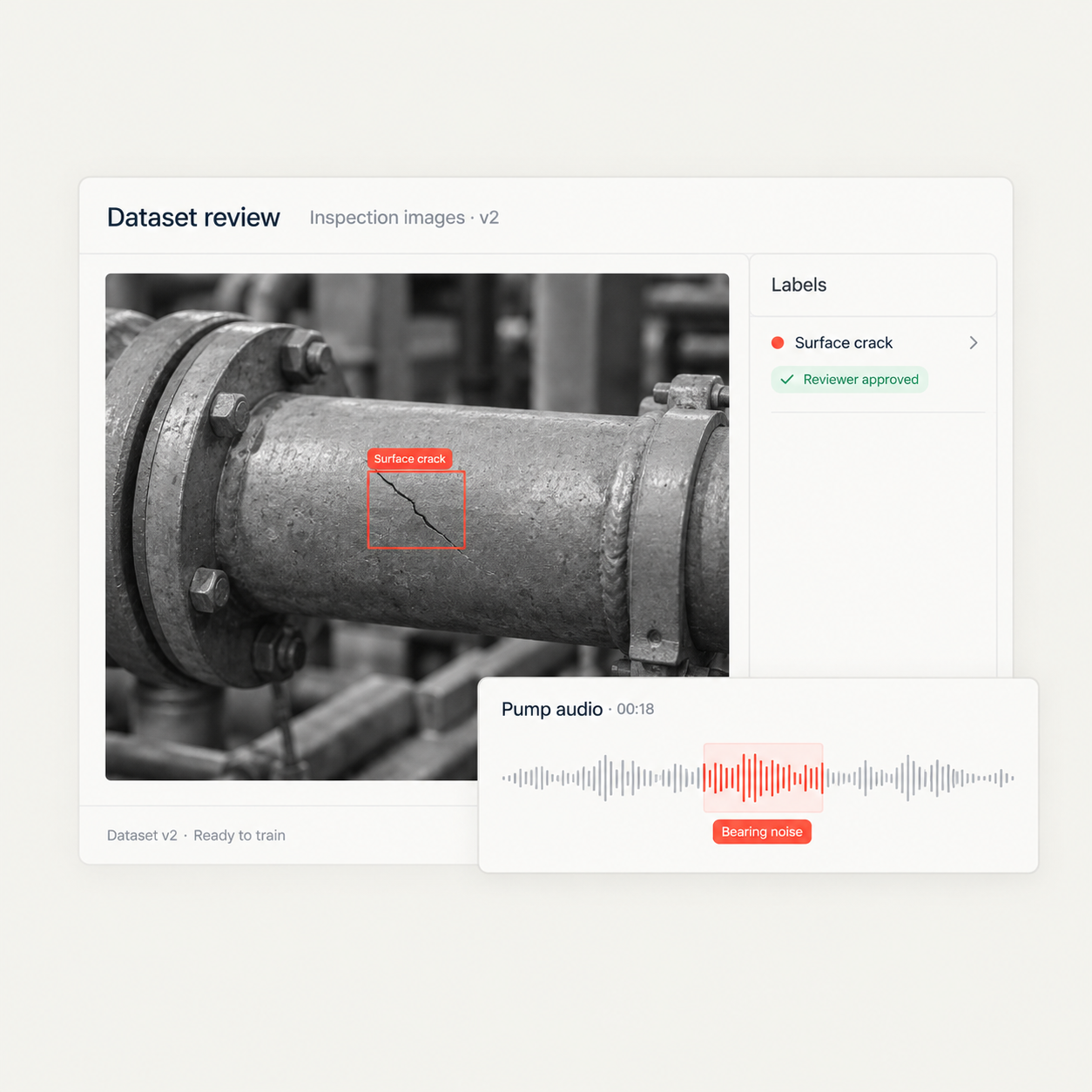
    Real-world data, recorded for the model you’re training.Speech, video, sensor, image and document data, captured with consent and labelled by people who know the domain.

    • Data collectionFour modality groups, from egocentric video to contact-center calls, recorded to your spec.
    • Data annotationAnnotators trained on your guidelines, with a second reviewer on every file.
    • Training-ready deliveryVersioned, documented datasets loaded straight into your DataObserve project.
    • Egocentric + sensor
    • Speech + audio
    • Image + video
    • Text + documents
    • Consent-managed capture

    // Next steps

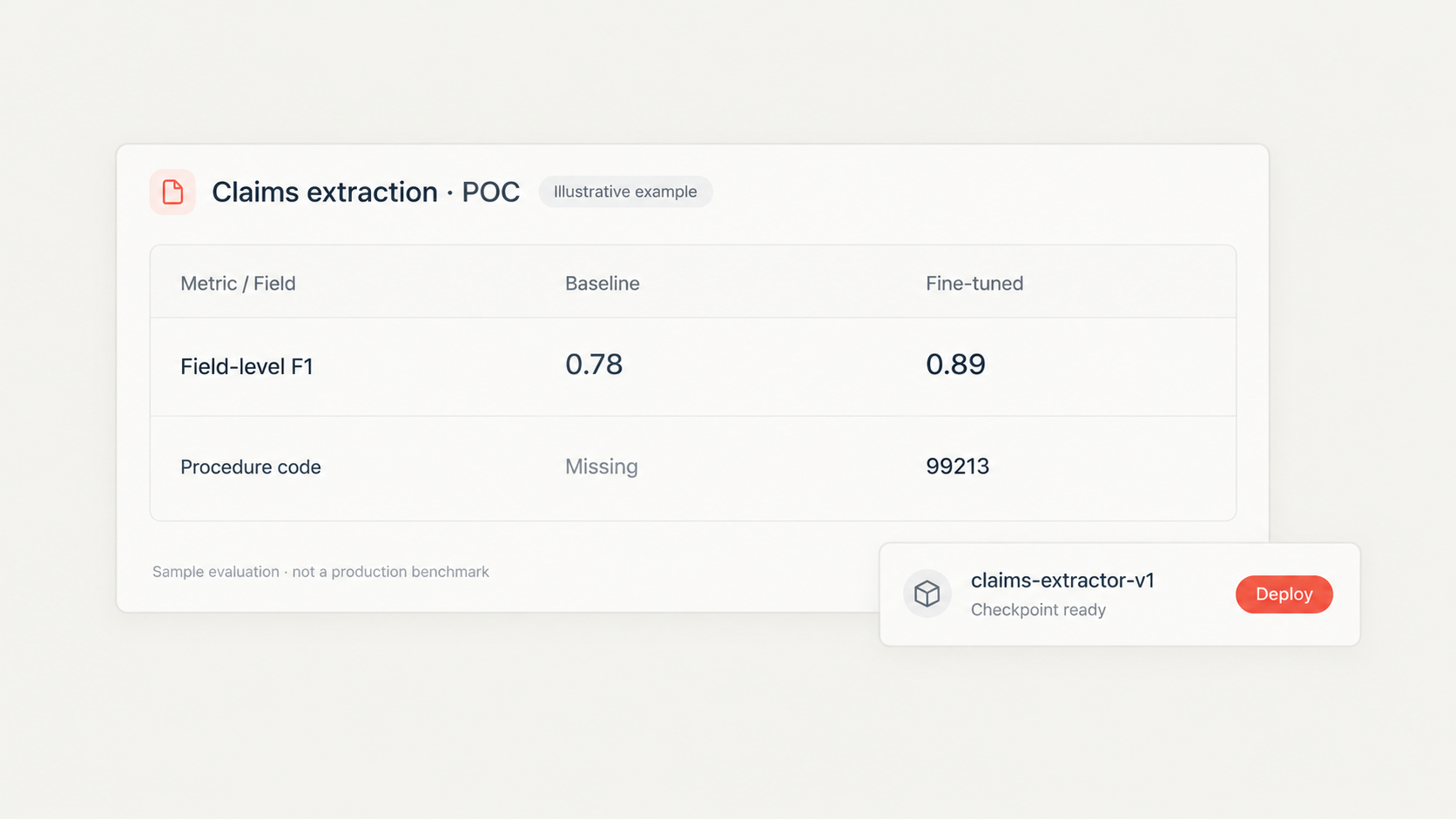
    Tell us what you’re training.We’ll build a proof of concept.

    • Review your current model, data and evals
    • Pick the open-weight base model that fits
    • Run a first training job on your data
    • Compare it against your baseline

    // Designed for enterprises

    We safeguard your company data and protect workspace privacy.

    Review security, data handling and deployment requirements with our team.

    • Security and privacy

      Keep sensitive information within your organization’s approved data boundaries.

    • Governance and access

      Define who can access connected data and which actions require approval.

    • Enterprise deployment

      Plan deployment around your infrastructure and operational requirements.

    We are HiringJoin the // Leap